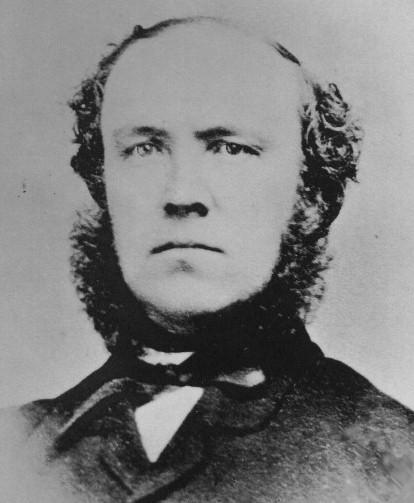
Colin Campbell III, Merchant and Shipbuilder
By Ian Murray Campbell, Nova Scotia
The author is a great-great-grandson of the Colin Campbell III who is the subject of this article. This Colin Campbell, ship owner of Shelburne, Nova Scotia, was the great-great-grandson of John Campbell, 5th of Barcaldine (ca 1700-1777). John became deeply involved in debt due mostly to his efforts to bring to justice the murderer of his half-brother Colin Campbell of Glenure, (see the book “The Appin Murder”). He sold his estates to his half-brother Duncan, who had inherited Glenure following Colin’s murder on the 1st of January, 1751. John’s great-great-grandfather was Patrick or (in the Gaelic) Para Dubh Beag, a younger son of Sir Duncan Campbell of Glenorchy, (one of the Baronets of Nova Scotia), and the founder of the Barcaldine family.
Colin Campbell III was born at Shelburne, Nova Scotia on 7 August 1822. He was the oldest son of Colin Campbell II (1798-1878) and Maria Taylor (1790-1873), and the grandson of Colin Campbell I (1752-1835)
The elder Colin had been born at Inveraray in June 1752. It is said that Colin came to America with his father or his brother Archibald and that there were five other brothers who also came making seven in all. He had a sister Helen and possibly other sisters living in Scotland. Most of his brothers were officers of rank in the British forces in America. Some of these in the 42nd regiment of Black Watch.
He had become a notary public in New York in 1782 and went to Nova Scotia with the Loyalists the following year where he became a Notary. He firstly married Alice Hogg, daughter of his partner. He married secondly Elizabeth Hardy, daughter of Loyalist Richard Hardy, a relation to Sir Josiah Hardy, Colonial Governor of New Jersey in 1761.
After the death of his second wife, Colin moved to St. Andrews, New Brunswick, where was firstly Collector of Customs, then Supervisor of Customs for the Maritime Provinces and Commissioner of Crown Lands under commission of King George IV. He represented Shelburne in the Provincial Legislature for 35 years. He died on 20 July 1835 and is buried in St. Peter’s church in Weymouth North, NS
Colin Campbell II and his wife Maria moved from Shelburne to Weymouth shortly after the birth of Colin III and their children were brought up at Weymouth. He was a Registrar for Digby County and also a Notary Public. He was also a founding member and subsequent master of the Widow’s Friend Lodge in Weymouth, Nova Scotia. He died in 8 September 1878.
Colin III received his education at Weymouth and Digby. Like many merchants in the Maritime Provinces during the latter half of the nineteenth century, the third Colin was a master mariner, operated a general store, carried on an extensive timber trade, built and operated his own vessels, and was politically active on the provincial level. Campbell began as a merchant at Weymouth (now Weymouth North) in the early 1840’s. His first vessel was the “Cygnet”, a schooner of 60 tons built by Henry Bart at Weymouth in 1848. Two years later he became the master and owner of a small brigantine, and the next year he owned a quarter share in the “Maria”, a new Brigantine of 136 tons built at Weymouth by George Taylor.
In 1854, Campbell established his own yard near his general store at Weymouth. Over the next 27 years he build eighteen vessels, including thirteen barques, three brigantines, a brig and a schooner. All but one were built at Weymouth with Reuben Hankinson as the master builder, and all were named for members of the Campbell family.
The first vessel built in the Campbell yard was the “Colin Campbell”, a brig of 169 tons launched in July of 1854. Campbell built the “Douglas”, a brigantine of 110 tons in 1857 and the “Charlotte” a schooner of 71 tons in 1859 before launching his first barque, the “Helen Campbell” of 274 tons in August of 1860. From then onwards both his output and the size of his vessels steadily increased.
His first two large barques were the “Susan L. Campbell” of 599 tons, launched in July of 1863, and the “Minnie Campbell” of 664 tons, launched in November of 1865. Over the next ten years six more barques and a brigantine were added to the Campbell fleet. The largest of these were the “Agnes Campbell” of 690 tons, built in 1870 at a cost of $29,559; the ”Harriet Campbell” of 649 tons, built in 1873 at a cost of $30,872, and a second “Susan L. Campbell” of 727 tons, built in 1875 at a cost of $34,336.
Three more large barques were added to the Campbell fleet: the “Douglas Campbell” of 875 tons, built in 1876; the ‘Harry Douglas of 1,112 tons, built in 1877, and the “Campbell” of 1,155 tons, the largest and the last of the
Campbell vessels built in 1879.
After 1854 Colin Campbell was the sole owner of all of his vessels until 1873 when his son George Douglas Campbell held a quarter share of three of them. Another son, John, acted as his father’s agent in London. Campbell enjoyed considerable success with his vessels. While a few only lasted three or four years, over half were under his ownership from eight to thirteen years. At the time of his death in 1881, eight vessels flew the Campbell house flag. The fleet included a brigantine and seven barques, and represented 6,000 tons of shipping valued at over $800,000.
In 1871 Campbell joined partnership with George Johnson and carried on a dry goods and grocery business at Weymouth Bridge (now Weymouth). Campbell held three quarters of the shares and Johnson held one quarter. The partnership was known as Colin Campbell and Co., and continued until his death.
In addition to his store and his fleet of vessels, Campbell was agent at Weymouth for the Merchants Bank of Halifax. In April, 1872 he formed the Weymouth Marine Insurance Company of which he was president. The company ran into financial difficulties in October, 1878, and, closed the following year.
Campbell also had a very active political career. He served as a Member of the Legislative Assembly for Digby in the Howe government from 1859 until 1867, and after Confederation served in the Hill government from 1857 until 1878. He also sat on the Executive Council from November 30, 1860 until June 5, 1863 and from June 19, 1875 until October 15, 1878. He was a Liberal-Conservative and voted for extension of the railways by the government, free schools, and Confederation.
On December 9, 1845 Campbell married Phoebe Ann, daughter of Josiah Gilbert Seeley of Saint John, New Brunswick. They had a family of ten children; four boys and six girls born between 1846 and 1862. His home, “Beechwood,” was located across the road from the store and shipyard at Weymouth North. His wife died on October 28, 1904 at the age of 82.
On Saturday, June 24, 1881, Colin died suddenly of a heart attack. The store at Weymouth taken over by his son George Douglas who operated under the name of G.D. Campbell. The fleet of vessels was to be sold but, the sons disputed Colin’s will and a court case followed “Campbell vs. Campbell” In 1895, the vessels that still remained in the fleet were sold.
 campbellreunions.com
Leave a comment